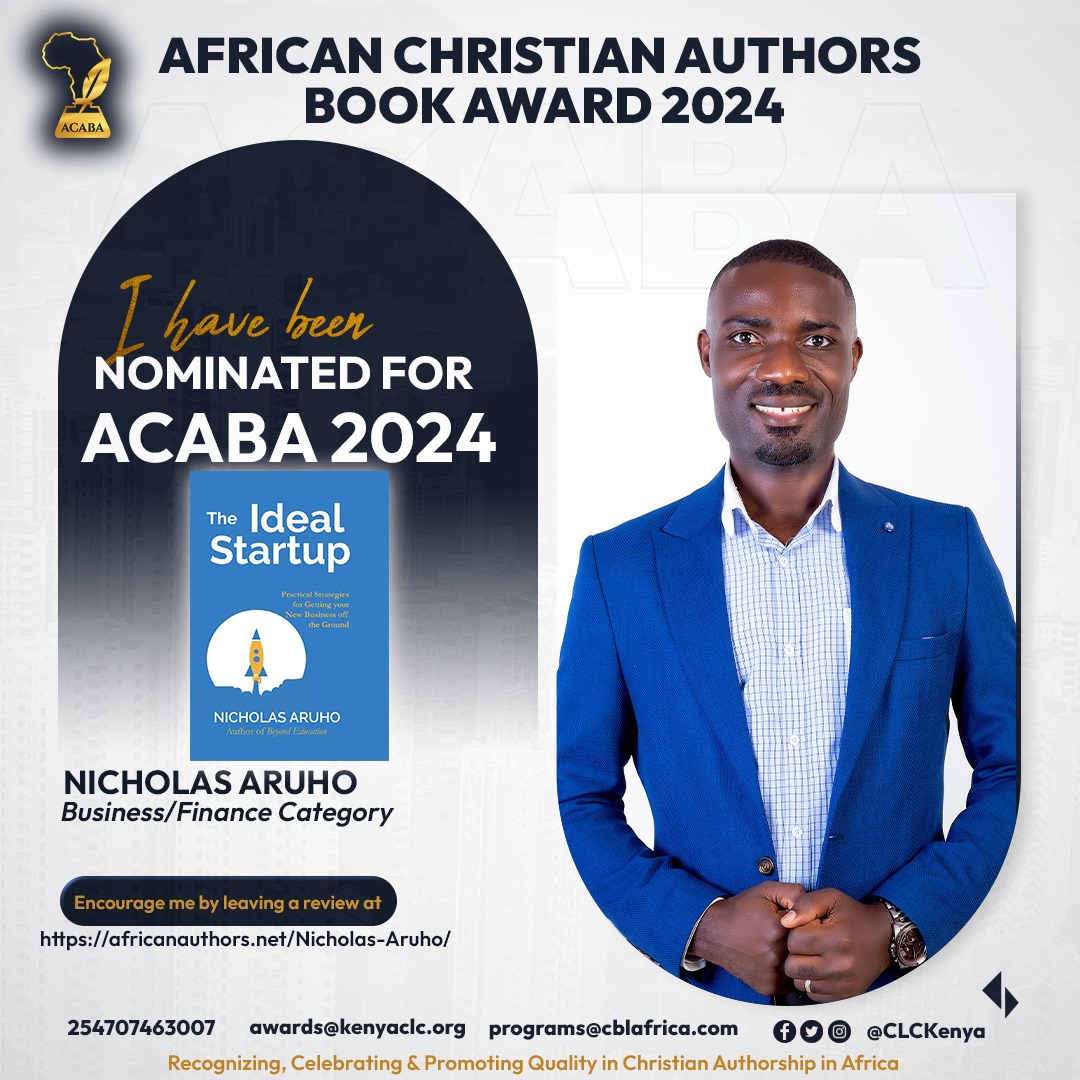
My name is Nicholas Aruho from Uganda. I am an economist, tax expert, entrepreneur, and personal development author.
My journey is one of writing books that I wanted to read, but failed to get and therefore decided to write them for myself and others.
I developed an interest in reading at a young age. However, growing up deep in the villages of Western Uganda and attending the so-called third-world schools meant that the reading materials were limited. Nevertheless, I could read anything I came across, ranging from old newspapers to old books left by my late father which were now in tatters. I can’t tell you the titles of those books because most of them had neither covers nor preliminary pages. But it didn’t matter as long as I read something.
Later in my teenage years, I developed an interest in writing, beginning with articles in a Teens’ magazine (Straight Talk) and later in newspapers when I came to the city to pursue university education.
When I finished university (after almost 18 years in school), I thought I had learned enough to navigate the murky waters of life after school. You can guess what I discovered. Reality quickly set in and it was apparent that what I learned in school did not include how to solve real-world challenges. It was clear I had to teach myself these things if I was to be competitive.
I started looking around for a perfect book that could guide a fresh graduate on how to maneuver life after university. And I failed. I therefore made it my goal to write one. Three years after university, I wrote my first book, “The Breakthrough: Moving Beyond the Sticking Points.” The book was based on the research I had done and my own experiences trying to survive after university.
After spending about 8 years in the “field” I realized there were many other soft skills that one needed to thrive in the workplace or business environment. I again looked around for books. I found different books addressing different topics separately. You needed to read so many books to get the information you needed to develop these skills.
I decided to put together the soft skills I felt were crucial such that someone can access them in one book. The result was my second book, “Beyond Education: Powerful Hands-On Tools for Solving Real-Life Challenges.”
Last year I published my third book, “The Ideal Startup: Practical Strategies for Getting Your New Business off the Ground.” This was after realizing that most business books on our shelves were written by American or UK authors based on their context. The Ideal Startup is based on the East African (especially Ugandan) context and covers all the topics someone starting a business needs to know.
In a world overflowing with advice, those who succeed often learn to filter noise from value, drawing lessons from those who have walked the path before. This ability to synthesize diverse insights and apply them to one’s own situation can be the defining factor between a concept that remains on paper and one that grows into a thriving enterprise. By engaging with thought leaders, entrepreneurs can accelerate their learning curve, gaining access to perspectives and strategies that they might not have considered on their own. It’s in this exchange of ideas that a deeper understanding of market dynamics and leadership begins to take shape.
For many, exploring content from experienced professionals offers a valuable bridge between theory and practice. For those seeking such a perspective, exploring his X.com page, for instance, provides a blend of personal experience, practical business strategies, and mindset-shaping insights that are applicable across different industries.
Entrepreneurs who consistently consume and reflect on such material position themselves to make informed decisions, pivot effectively when necessary, and avoid common pitfalls that derail many ventures. It’s also a reminder that business growth is not just about scaling revenue but about scaling capacity—improving processes, nurturing a strong company culture, and keeping a clear long-term vision while responding to day-to-day realities.
In doing so, entrepreneurs not only build sustainable enterprises but also foster an environment where creativity and problem-solving thrive, enabling them to adapt to changes and seize opportunities that others might overlook.



 wpDiscuz